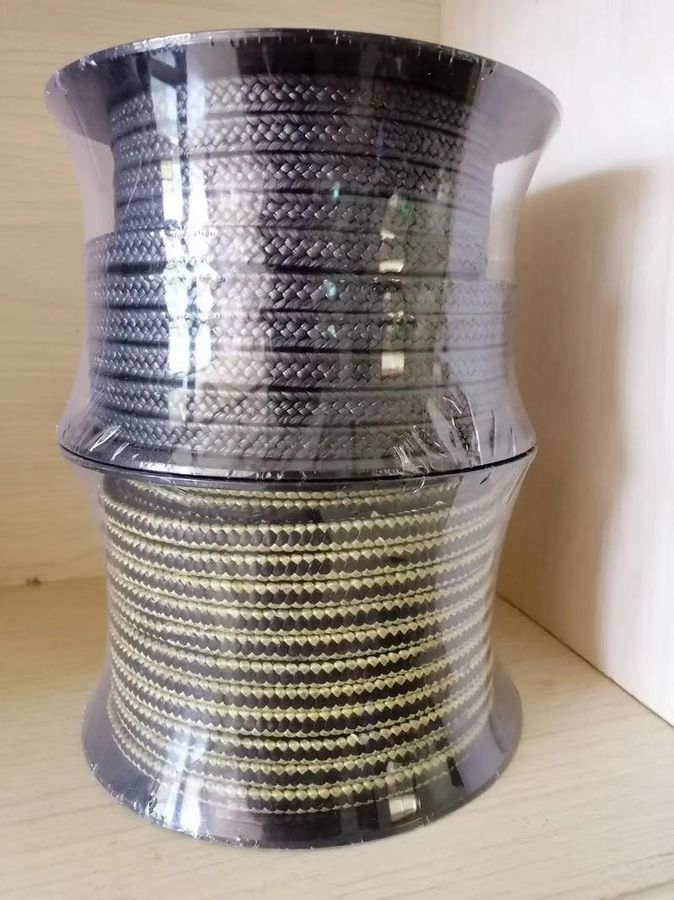
Gland packing seals the rotating shaft of pumps, valves and agitators. It is inexpensive and easy to replace — but choose the wrong material, or install it badly, and you will have a permanent drip at best, or a scored shaft sleeve at worst.
1. Four packing types compared
| Type | Temperature range | Chemical resistance | Characteristics | Not suitable for |
|---|---|---|---|---|
| Flexible graphite packing | -200 to 650 °C (non-oxidising media) | Acids and alkalis, except strong oxidisers | Good heat dissipation, versatile, best value | Strong oxidising media; direct food or pharmaceutical contact |
| PTFE packing | -100 to 260 °C | Excellent — almost all acids, alkalis and solvents | Clean, does not contaminate the medium, low friction | High temperature with high pressure; high shaft speed (cold flow) |
| Aramid packing | -100 to 250 °C | Moderate | High strength and abrasion resistance; resists particle-laden media | Strong alkalis at high temperature; low-hardness shaft sleeves |
| Carbon fibre packing | -100 to 450 °C | Good | Heat dissipation, abrasion resistance, high temperature | Tight budgets and ordinary low-speed, low-pressure duties |
Standard sizes are in stock — see gland packing. For fire pumps and duties requiring flame retardance, use fireproof packing.
2. Selection in five questions
- Does the medium contain particles? Slurry, sand or crystallising media → aramid or carbon fibre for abrasion resistance
- How aggressive is the chemistry? Strong acids, alkalis or solvents → PTFE packing is the safest choice
- What is the temperature? Above 260 °C → graphite or carbon fibre; below that, the other factors decide
- What is the shaft speed? High-speed pumps should not use pure PTFE (cold flow plus frictional heat); use aramid, carbon fibre or a combination construction
- What are the shaft and sleeve materials? With soft sleeves, avoid high-hardness packings or fit a protective sleeve
3. Installation — six rules
- Remove all old packing and clean the stuffing box and shaft of scale and rust
- Cut rings to length with a 45° mitre — never a straight cut
- Stagger each ring’s cut by at least 90° so the joints do not line up
- Tamp each ring down individually with a proper tool — do not fully tighten the gland in one pass
- Allow a slight weep in service (typically 20–60 drops per minute, depending on duty) so frictional heat is carried away
- After running in, tighten the gland evenly in stages until leakage is at an acceptable level
4. Four mistakes that cause failures
- Mixing different packing types — expansion rates and friction coefficients differ, so one ring always fails first
- Over-tightening the gland — leakage stops briefly, frictional heat cannot escape, and the packing burns and scores the sleeve within hours
- Replacing packing on a worn sleeve — the groove keeps cutting the new packing. Repair or replace the sleeve first
- Forcing the wrong cross-section — if the packing size does not match the stuffing box, it cannot seal. Specify square or round section to match the box
5. When a combination set makes sense
In extreme duties — high temperature with particles, or aggressive chemistry at higher shaft speed — a single material is usually a compromise. The common approach is a combination set: graphite rings at the ends for heat and abrasion resistance, PTFE rings in the middle as the chemical barrier, and possibly a metal lantern ring in between. These are configured to the specific duty, so send us the equipment data.
Related reading: how to choose rubber sheet thickness, and material comparison for flange gaskets.
Need a packing quotation? Provide the equipment type (pump, valve or agitator), medium, temperature, pressure, shaft diameter, stuffing box cross-section and quantity via our contact page. Graphite, PTFE, aramid and carbon fibre are in stock in standard sizes, and cut lengths are available to order.