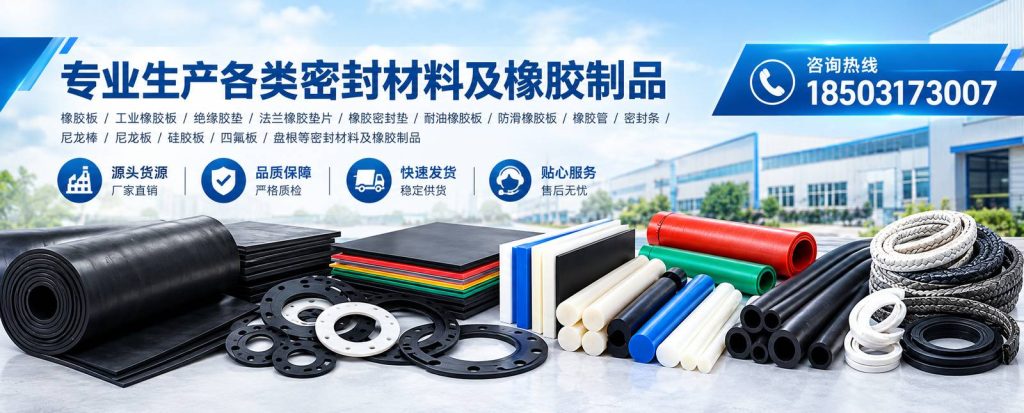
If you are sourcing rubber sheet, flange gaskets or gland packing, the words “Hejian, Hebei” come up quickly. As a manufacturer based there, I want to give a straight account of what this region is genuinely good at — and how to vet a supplier you will never visit in person.
1. Why Hejian became a sealing materials cluster
Rubber and sealing production in Hejian began in the last century and has grown into a complete chain — from raw compound, formulation and calendering through moulding to tooling. That concentration produces three concrete advantages:
First, the supply chain is complete. Making rubber sheet requires internal mixing and calendering equipment; gaskets need dies and punching; packing needs braiding machines. All of that support is available within a few kilometres, with no need to source across provinces.
Second, the process knowledge is mature. Decades on the same products gives real hands-on experience. Take EPDM sheet: filler ratios and cure times directly affect weathering life, and that detail is passed down inside the cluster.
Third, the size range is wide and minimum order quantities are flexible. Specialisation means you can find someone to run 1 mm sheet, 50 mm slab, or a shaped gasket to drawing. That suits buyers with small quantities.
Our own range covers industrial rubber sheet, flange gaskets, PTFE sheet, silicone sheet, insulating rubber mat and gland packing, plus custom gaskets.
2. What a buyer actually saves
The middleman margin. Buying from the factory removes a trading layer, so both price and lead time become more controllable.
Communication overhead. Send one drawing and the tooling and machining can be sourced locally, instead of being relayed between several companies.
Trial cost. Sample, inspect, adjust the compound, then run the batch — that loop turns fast inside a cluster.
3. Five checks for an overseas buyer
Any cluster contains both serious factories and small workshops. The question is not “where was it made” but “is this particular supplier reliable”. Work through these checks:
1. Ask for test reports, not verbal assurances
For rubber sheet, the usual parameters are hardness (Shore A), tensile strength, elongation at break and specific gravity. For insulating mats, the dielectric strength report is essential — it is a safety product, not an optional extra.
2. Test a sample; do not compare price alone
Two sheets both described as “5 mm × 1 m × 10 m” can differ 20 % in weight. Ask suppliers to quote size + weight + price per sheet, not only a per-kilogram rate. Weigh and measure the sample before you decide.
3. Ask whether they actually manufacture
Some suppliers only resell. Ask “do you calender the sheet yourselves?” and “can you select sheets within my thickness tolerance?” Vague answers are a warning sign.
4. Start with a small trial order
Do not open with a large PO. Run a small batch and check lead time, packing and actual performance before scaling up.
5. Put the critical items in writing
Compound (down to the rubber type), dimensions and tolerances, hardness range, lead time and packing method. When it is written down, disputes largely disappear.
4. When to buy direct from a factory
- Non-standard dimensions — standard parts are available locally; special sizes need a factory
- Specific compounds — oil resistance, flame retardance, anti-static or high temperature, which general-purpose sheet cannot provide
- Made to drawing — you have a drawing or sample and want a small trial run
- Repeat supply — fixed equipment and conditions, requiring consistency between batches
If any of those describes you, send the drawing or sample photo. See our applications page, or simply contact us — we will advise on compound and specification first, then quote for comparison.
5. In one line
A cluster gives you complete supply, mature process, wide sizes and flexible MOQs. Final quality still comes down to which supplier, which compound, and whether there is test evidence. Judge suppliers on documentation, samples and responsiveness — not on where they are located.
Want a sample or quotation? Use our contact page with the application, specification and quantity — we reply the same working day.