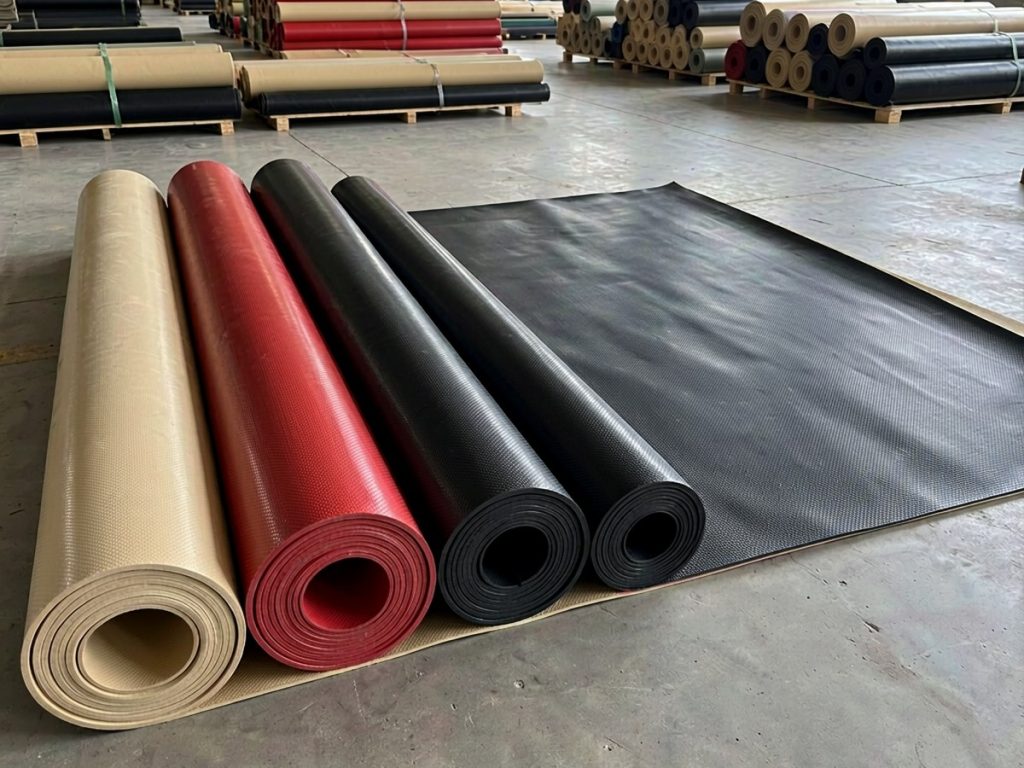
The rubber mat laid in front of switchgear, in a transformer room or under a generator is an insulating rubber mat. It is a safety product — specify the wrong grade and you may as well not have laid it. This guide explains how voltage ratings work, how to choose, and what to check on delivery.
1. One rule first: rating follows the voltage, thickness follows the rating
An insulating mat has one critical parameter: its withstand voltage rating (power-frequency withstand). That determines the highest system voltage it may be used with — and the rating in turn depends on thickness. Insufficient thickness cannot deliver the rating.
These are the working relationships used in the market (practical guidance — always confirm against the product test report and the standard the mat is made to):
| Voltage rating | Typical thickness | Typical application |
|---|---|---|
| 5 kV | 3 mm | LV distribution rooms, in front of control cabinets |
| 10 kV | 5 mm | General switch rooms, packaged substations |
| 15 kV | 6 mm | MV distribution rooms |
| 20 kV | 8 mm | MV switchgear and substation operating areas |
| 25 kV | 10 mm | HV cubicles, generator rooms |
| 30–35 kV | 10–12 mm | HV distribution areas |
Put simply: higher voltage requires a thicker mat. Do not “make do” with a thinner one — this is safety equipment and the margin is not a place to save money.
We supply insulating mats in a range of widths, thicknesses and colours — see insulating rubber mat.
2. Four more parameters to check
- Tensile strength and elongation at break — indicates elasticity; brittle mat cracks under foot traffic
- Hardness (Shore A) — too soft and tools cut it; too hard and it loses grip
- Specific gravity — two mats of the same size can differ significantly in weight, which matters if you buy by weight
- Ageing resistance — switch rooms are dry and often have ozone present; the mat must survive several years without cracking
Two further points: colour (black, red, green) is normally used to mark zones or provide visual warning — follow the end user’s own acceptance requirements; and surface finish may be smooth or cloth-patterned (anti-slip). Choose the patterned finish where oil or water may be present.
3. Selection in four steps
- Fix the voltage rating — based on the highest system voltage in the room; keep one rating step in reserve
- Fix the thickness — follow the rating, as in the table above
- Fix the dimensions — calculate the floor area, and use standard widths (1 m / 1.2 m) and roll lengths (5 m / 10 m) to minimise joints
- Fix any special requirements — anti-slip surface, specified colour, oil or heat exposure
4. Acceptance and maintenance — where projects go wrong
On delivery:
- Require a third-party test report (look for CMA or CNAS accreditation; the rating and thickness on the report must match what was ordered)
- Measure thickness at several points, including the corners — not just the middle
- Inspect for blisters, cracks, inclusions and obvious colour variation
In service:
- Clear the floor before laying; no nails, swarf or sharp edges beneath the mat
- Butt joints neatly with no gaps
- Carry out periodic preventive withstand testing — most operators do this annually, per their own safety rules
- Replace immediately if the mat cracks, hardens, crumbles or thins noticeably
5. Three low-price traps
- Reclaimed rubber sold as insulating mat — much cheaper, but it cannot hold the rating. That is a safety hazard, not a bargain
- Under-thickness — described as 5 mm, measuring 4.2 mm. The rating is then nominal only. Always measure
- A test report for a different batch or size — check that the model and dimensions on the report match the goods
One clarification: if the requirement is both insulation and static dissipation, that is a different product — see anti-static rubber sheet. For general industrial flooring, use industrial rubber sheet. They are not interchangeable.
Need a quotation for insulating mat? Tell us the voltage rating, thickness, width, length, quantity and any colour requirement via our contact page. Standard sizes are in stock; non-standard sizes are made to order.