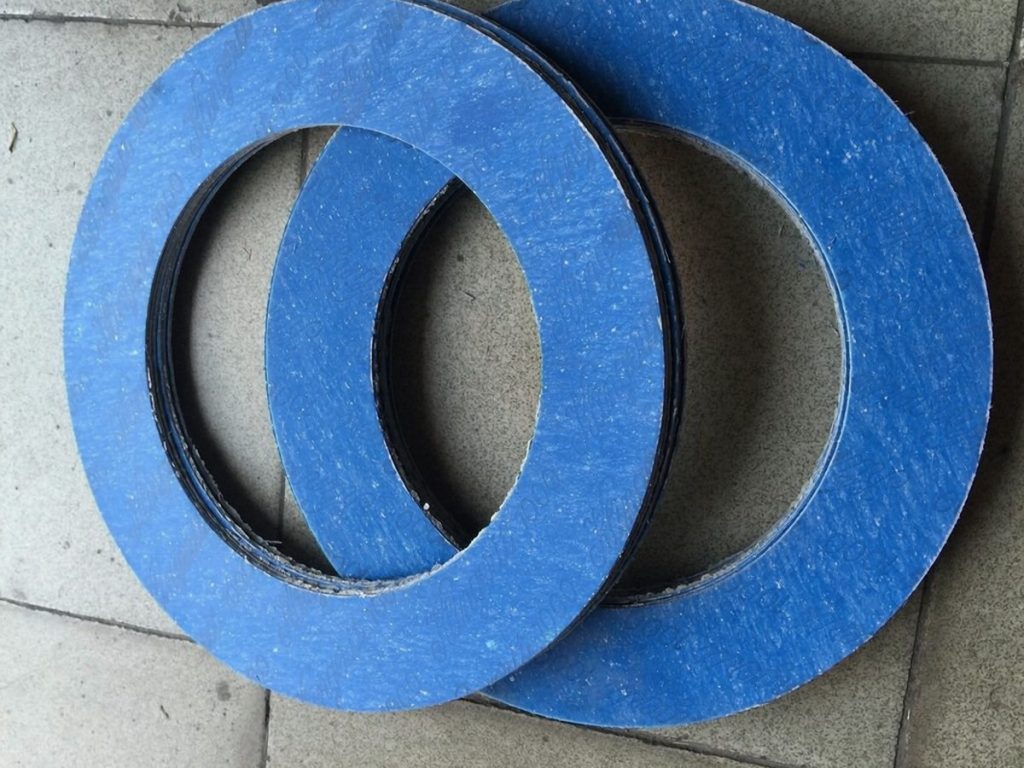
“Can we still use asbestos gaskets?” is one of the questions we are asked most often. The honest answer is: in some applications asbestos sheet remains a proven material, but there are clear limits — and anything involving drinking water, food and pharmaceutical contact, or export to the EU/US, must be non-asbestos.
This guide explains where asbestos is still acceptable, where it must be replaced, and what to replace it with.
1. Why asbestos is restricted
Asbestos fibres released during cutting, handling and ageing can be inhaled and cause serious lung disease. As a result:
- European Union — asbestos and asbestos-containing products are banned under REACH;
- United States — most asbestos uses are restricted or banned (tightened in recent years);
- China — certain asbestos products are prohibited and strict protective measures apply to handling;
- Food, pharmaceutical and drinking water — non-asbestos materials are required.
So the material is not “unusable” — it has a defined boundary. Outside that boundary, replace it.
2. Where it can still be used — and where it cannot
| Application | Asbestos sheet acceptable? | Notes |
|---|---|---|
| High-temperature steam, hot oil, flue gas lines (industrial, no direct personnel contact) | Yes | The classic application for compressed asbestos fibre sheet — stable at temperature and pressure, low cost |
| Frequent cutting and re-assembly | With caution | Cutting releases fibres; protective procedures are mandatory |
| Drinking water, food, pharmaceutical or cosmetic contact | No | Non-asbestos is mandatory in these industries |
| Confined or poorly ventilated spaces | No | Fibres cannot disperse; high exposure risk |
| Export to the EU, US, Japan and others | No | Compliance risk — customers will reject the goods |
| Equipment frequently serviced by staff | Replace recommended | Switching to non-asbestos makes maintenance safer |
3. Non-asbestos alternatives compared
| Material | Temperature range | Pressure | Suits | Not suitable for | Typical use |
|---|---|---|---|---|---|
| Non-asbestos fibre rubber sheet (NAF) | -50 to 200 °C | Low to medium | Water, steam (medium pressure), oils, mild acids and alkalis | High temperature with high pressure; strong solvents | The most versatile direct replacement |
| Flexible graphite composite | -200 to 450 °C | Medium to high | High-temperature steam, hot oil, flue gas | Strongly oxidising media | The high-temperature upgrade |
| PTFE gasket | -100 to 260 °C | Low to medium | Strong acids, alkalis, solvents | High pressure at high temperature; cold flow | Aggressive chemical service |
| Spiral wound gasket | -200 to 600 °C | High | High-temperature, high-pressure piping | Rough flange faces; frequent opening | HP steam, district heating networks |
We supply all of these: asbestos rubber sheet and gaskets (with compliant-use guidance), spiral wound gaskets, PTFE sheet and gaskets, and non-asbestos fibre sheet on request.
4. Four-step replacement selection
- Temperature first — up to 200 °C: non-asbestos fibre; 200–450 °C: graphite composite; above 450 °C: spiral wound;
- Then the medium — corrosive or solvent service: PTFE; strongly oxidising media: avoid graphite;
- Pressure and flange condition — high pressure: spiral wound; rough faces: a softer non-asbestos or graphite composite;
- Compliance last — drinking water, food, pharma or export: choose non-asbestos and keep the material certificate.
5. Four questions we are asked most
Q1. Is non-asbestos sheet strong enough?
For low and medium pressure duties, yes — many non-asbestos fibre sheets have better compression recovery than asbestos. The real difference appears at high temperature and pressure, where the correct answer is graphite or spiral wound rather than asbestos sheet.
Q2. What about the price difference?
Non-asbestos fibre sheet usually costs somewhat more per sheet because of raw material cost, but the compliance and safety benefits outweigh it. Graphite composite and spiral wound gaskets cost more again and are specification upgrades rather than direct replacements.
Q3. Can we finish the asbestos stock we already have?
If the application falls within the “acceptable” rows in section 2, yes — provided that cutting and handling use respiratory protection, dust is suppressed, waste is disposed of under hazardous-waste rules, and nothing is used in food or drinking water systems.
Q4. A customer asks for a “contains no asbestos” declaration — what do we do?
Specify a non-asbestos material at the purchasing stage and keep the certificate with the shipment. Never supply asbestos while claiming otherwise — the consequences on export inspection are severe.
6. In one line
Use asbestos only for industrial high-temperature, high-pressure service with no personnel exposure, no food or drinking water contact and no export compliance requirement. In every other case, select from the non-asbestos table above.
Related reading: how to choose flange gasket material; rubber sheet thickness guide.
Not sure which material fits? Send us the temperature, medium, pressure and flange size via our contact page — we reply with an alternative and a quotation the same working day.