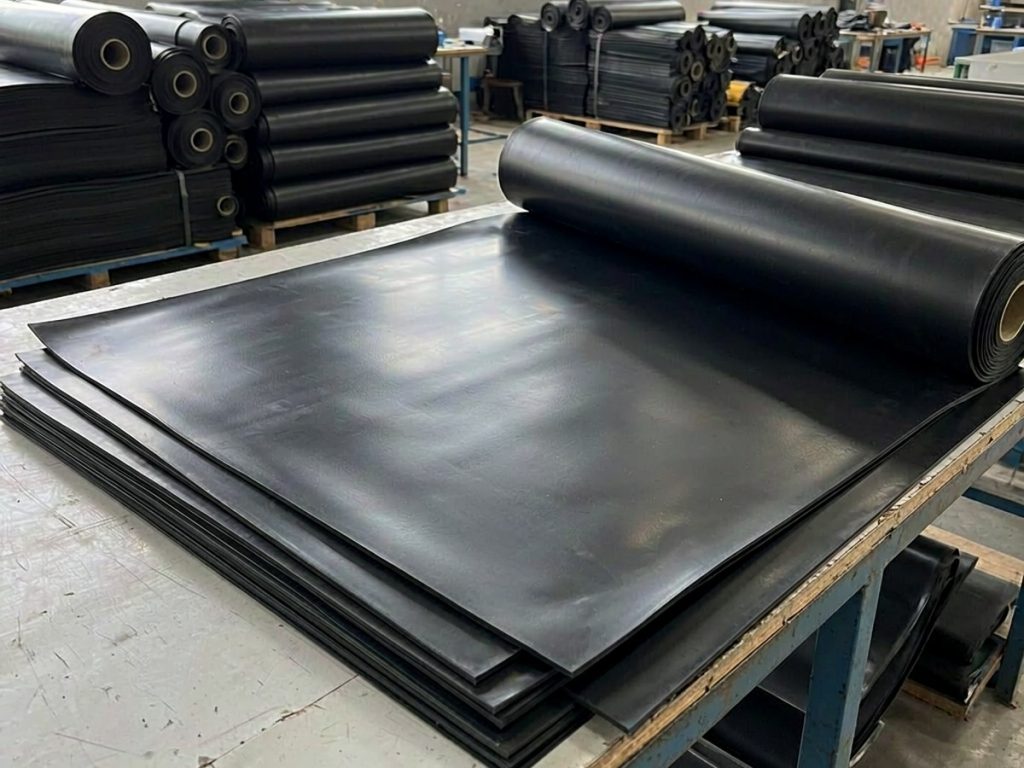
“How many years will your EPDM rubber sheet last outdoors?” is one of the questions we hear most. There is no single answer: two sheets both sold as “EPDM” can differ several times over in service life, because compound quality and working conditions dominate. This article explains what actually drives the lifespan, how ageing shows up, and how to decide when to replace.
1. Typical service life ranges
Under normal conditions (no strong acids, no continuous oil contact, no sustained high temperature), a well-made EPDM sheet typically delivers:
| Environment | Typical life | Main driver |
|---|---|---|
| Indoor, dry, no direct sunlight | 8–15 years or more | Temperature, ozone |
| Outdoor, UV exposure, wide temperature swings | 5–10 years | UV, ozone, thermal cycling |
| Outdoor plus continuous water or steam | 4–8 years | Hydrolysis, wet–dry cycling |
| Continuous high temperature (above 100 °C) | 1–3 years | Heat ageing — life drops sharply |
| Contact with mineral oil | Not recommended | EPDM swells in mineral oil |
These are practical ranges, not guarantees. See the EPDM rubber sheet page for specifications.
2. Five factors that determine the lifespan
1. Compound quality — the ceiling
EPDM performance depends on base polymer grade, filler loading and cure system. More filler (e.g. calcium carbonate) means lower cost but faster ageing. “EPDM sheet” is sold at specific gravities from about 1.3 to 1.8, and the lifespan gap comes mainly from the compound, not the country of origin.
2. UV and ozone
EPDM is among the most weather-resistant general-purpose rubbers, but prolonged strong UV exposure still hardens the surface and produces fine cracking. Outdoors, avoid installing the sheet under permanent tension — stressed areas crack first.
3. Temperature
Temperature is the harshest factor. As a rule of thumb, every 10 °C increase roughly doubles the ageing rate. The same sheet may last 8 years at 60 °C and only 1–2 years at 120 °C.
4. Media contact
EPDM excels with water, steam, hot water, mild acids and alkalis, ozone and outdoor exposure. Its weakness is mineral oil, hydraulic oil, petrol and aromatic solvents — these swell it. Where oil and weather resistance are both needed, use NBR or FKM instead — see oil-resistant rubber sheet.
5. Mechanical stress
Sustained compression, tension or shear accelerates cracking. As a gasket, avoid over-compression; as a liner, avoid point loading.
3. Four signs it is time to replace
| Symptom | Meaning | Action |
|---|---|---|
| Fine surface cracking | Early UV/ozone ageing | Replace if cracks exceed about 1 mm or spread |
| Hardened, no elasticity | Heat ageing, poor recovery | High risk of sealing failure — replace |
| Noticeably thinner, edge loss | Abrasion or compression set | Cannot seal properly — replace |
| Swollen, soft, sticky | Wrong media contact (usually oil) | Change the material, not just the sheet |
4. Five ways to extend service life
- Select the right compound — confirm temperature and media before discussing thickness or size;
- Reduce working temperature — add insulation or ventilation where possible; the biggest single win;
- Avoid unnecessary UV exposure — shade, protective coating or a protective layer;
- Store correctly — dark, cool, away from oil, laid flat rather than hung (hanging causes permanent deformation);
- Inspect periodically — check gaskets during planned maintenance and replace cracked items before a leak appears.
5. What to tell a supplier to get a realistic answer
- Indoor or outdoor, direct sunlight or not;
- The medium involved (water, steam, oil, acid, alkali, gas);
- Working temperature range (ambient / 80 °C / above 100 °C);
- Static seal or dynamic contact;
- Any sustained compression, tension or shear.
Related reading: how to choose rubber sheet thickness, and material comparison for flange gaskets.
Need selection advice or a quotation? Send the five points above via our contact page — we reply the same working day. Standard thicknesses are in stock, with custom sizes and trial quantities welcome.