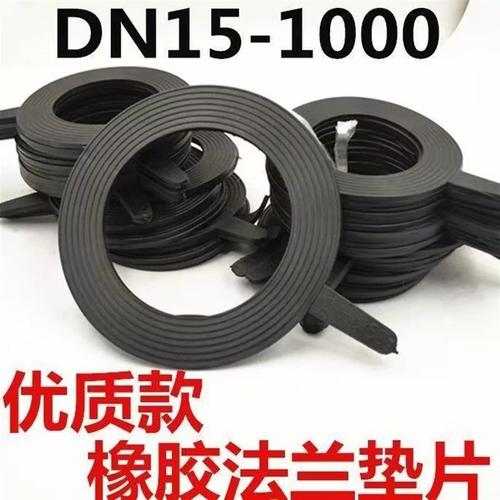
A flange gasket costs very little, but choosing the wrong material is expensive — from a permanent weep to an unplanned shutdown. After years of supplying sealing materials, the commonest mistake we see is this: materials are chosen on price rather than on duty.
Here are the four gasket families used most often in industry, compared side by side.
1. Comparison table: four gasket types
| Type | Common materials | Temperature range | Pressure | Suits | Not suitable for |
|---|---|---|---|---|---|
| Rubber gasket | Natural rubber, NBR, EPDM, FKM | -20 to 80 °C (FKM to 200 °C) | Low to medium | Water, air, mild acids and alkalis, oil (NBR) | High-temperature steam, strong solvents |
| PTFE gasket | Polytetrafluoroethylene | -100 to 260 °C | Low to medium | Strong acids, alkalis, solvents | High pressure at high temperature; cold-flow sensitive joints |
| Graphite gasket | Flexible graphite, graphite composite | -200 to 450 °C (composite depends on carrier) | Medium to high | High-temperature steam, hot oil, flue gas | Strongly oxidising media |
| Spiral wound gasket | Stainless steel winding with graphite or PTFE filler | -200 to 600 °C | High | High-temperature, high-pressure piping and flanges | Rough or uneven flange faces; joints opened frequently |
We supply all four families: flange gaskets, rubber sealing gaskets, PTFE sheet and gaskets and spiral wound gaskets.
2. Selection order: temperature, medium, then pressure
Step 1 — Temperature first
- Below 80 °C → rubber gasket; inexpensive and effective
- 80–260 °C → PTFE or graphite composite
- Above 260 °C → graphite or spiral wound
Step 2 — Then the medium
- Water, air, mild acids and alkalis → rubber or PTFE
- Oils → NBR gives the best value (see oil-resistant rubber sheet)
- Strong acids, alkalis and organic solvents → PTFE
- High-temperature steam → graphite or spiral wound
Step 3 — Finally pressure and flange condition
- Low pressure, sound flange faces → rubber or PTFE will do
- High pressure → spiral wound gasket
- Scored or uneven faces → avoid spiral wound; use a softer rubber or graphite composite that can flow into the imperfections
3. Four questions customers ask most
Q1. Is PTFE a universal solution?
No. PTFE resists almost every chemical, but it has two weaknesses: cold flow (it deforms gradually under sustained load) and poor thermal conductivity. In high-temperature, high-pressure joints the risk is greater than people expect. Those duties normally call for a PTFE-envelope gasket or a spiral wound gasket.
Q2. Which rubber is best for gaskets?
It depends on the duty:
- Oil → NBR (nitrile), our oil-resistant sheet
- Outdoor, weathering and water → EPDM, see EPDM rubber sheet
- Above 150 °C → FKM, see fluororubber sheet
- General water and air → natural rubber, the lowest cost option, see industrial rubber sheet
Q3. How thick should the gasket be?
Start at 3 mm for general flanges, and go to 5 mm where pressure is higher or the face is rough. Too thick is also a problem — the rubber is extruded past the flange edge as bolts are torqued and the joint stops sealing. Full detail is in our rubber sheet thickness guide.
Q4. The joint still leaks after replacement — what should I check?
Work through this order:
- Were the bolts tightened in a diagonal, staged, even pattern? (This is the most common cause — many people tighten each bolt fully in one pass.)
- Are the flange faces scored, distorted or pitted?
- Is the gasket bore much smaller than the pipe bore, obstructing flow?
- Is the material correct for the duty — for example, natural rubber in a hot line?
4. What we need in order to quote
Send these four items and we can quote without a round of questions:
- Flange size (DN) or gasket OD × ID × thickness
- The medium
- Working temperature and pressure
- Quantity
A photo of the old gasket — face and side — is ideal; we can usually read material and thickness from it. Shaped and non-standard parts are made to drawing or sample: see custom gaskets.
Need selection advice or a quotation? Send the four items above through our contact page. We are a sealing materials factory in Hejian, Hebei, China, with rubber sheet, gaskets, PTFE sheet and gland packing in stock — small orders welcome.