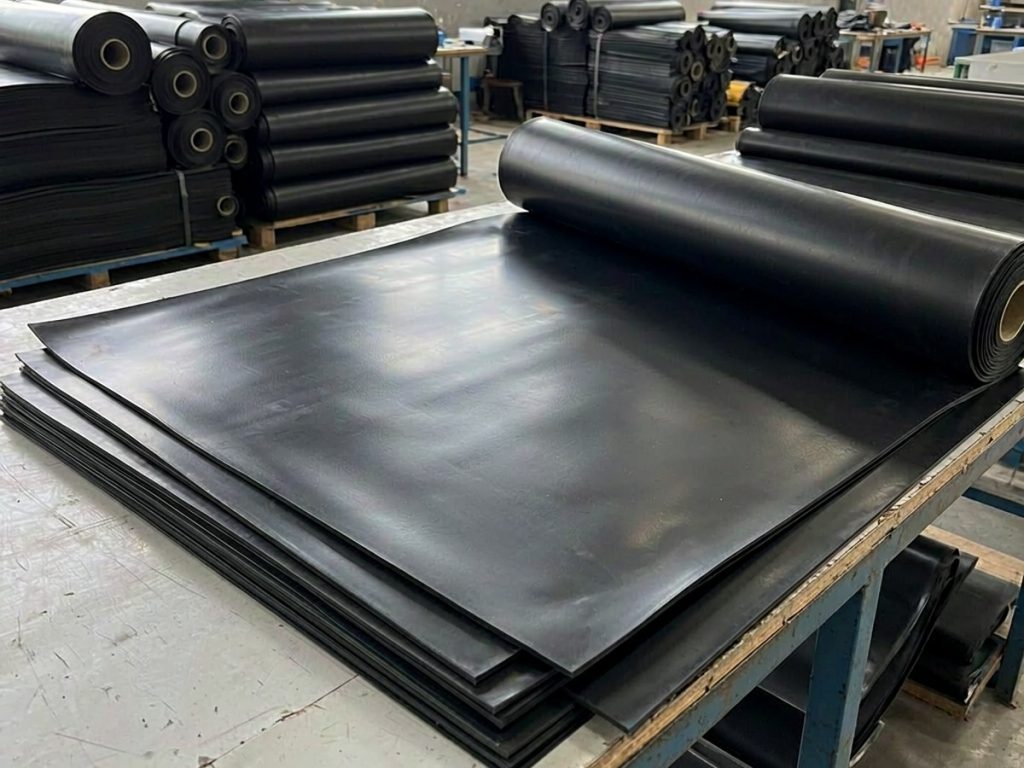
Rubber sheets are available from 1 mm up to 50 mm and thicker. Choose too thick and you pay for material you do not need; choose too thin and it will not last. This guide explains which thickness suits which application, and gives you a five-step method to specify the right one.
When a customer opens with “how much is your rubber sheet?”, we usually ask three questions first: where will it be used, what pressure will it take, and are there temperature requirements? Because “rubber sheet” covers everything from 1 mm to 50 mm, the wrong thickness can double your cost — or cause a leak.
1. Thicker is not automatically better
Thickness affects three things: load-bearing capacity, wear life, and price.
- Too thin: a gasket cannot seal properly under compression and will weep; a floor mat wears through in months.
- Too thick: costs more, and in some cases performs worse — an over-thick gasket gets squeezed out past the flange edge when bolts are torqued, so the sealing face no longer seats properly.
Specify the thinnest sheet that meets the duty. That is the engineering answer, and the cheapest one.
2. Common thicknesses and typical applications
| Thickness | Typical use | Notes |
|---|---|---|
| 1–2 mm | Small flange gaskets, instrument pads, sealing washers | Flat, well-machined faces and low pressure only |
| 3 mm | General pipe flange gaskets | The most common gasket thickness; best all-round choice |
| 5 mm | Medium flanges, enclosure seals, switch room insulating mats | Balances sealing and pressure resistance |
| 6–10 mm | Machine anti-vibration pads, flooring, workbench tops | Choose this band when abrasion and cushioning matter |
| 12–20 mm | Heavy machinery mounts, dock and wagon linings | High load and impact resistance |
| 25 mm + | Special vibration isolation, large liners | Usually made to drawing |
These are practical rules of thumb, not hard standards — pressure and temperature decide in the end.
3. Five steps to fix the thickness
Step 1 — Determine the medium. Water, oil, acid, alkali or gas? The medium decides the compound: NBR for oil, EPDM for weather and water, FKM for high temperature and solvents. Choose material first, thickness second. See oil-resistant rubber sheet and EPDM rubber sheet.
Step 2 — Determine the working temperature. Natural rubber is generally good to about 80 °C, EPDM to around 100–120 °C, FKM to about 200 °C. Above the limit, extra thickness will not help — the rubber hardens and loses elasticity.
Step 3 — Determine the pressure. Low pressure (mains water, atmospheric lines) — a 3 mm gasket is normally enough. Medium to high pressure means a thicker sheet, or a different construction such as a spiral wound gasket.
Step 4 — Check the flange face width. Narrow faces need thinner gaskets, otherwise the material will not compress evenly; wide faces can take a thicker sheet.
Step 5 — Allow a margin, but not an excessive one. If 3 mm calculates out and the flange face has light scoring, moving to 5 mm is sensible. Jumping straight to 10 mm “to be safe” costs more and is harder to install.
4. Three mistakes we see most often
Mistake 1 — Choosing thickness before material. Natural rubber sheet in an oil duty will swell within days, however thick it is. Material first, thickness second.
Mistake 2 — Ignoring tolerances. Rubber sheet is calendered, so thickness carries a tolerance (typically ±0.2 mm to ±0.5 mm, wider on thicker sheets). For precision work, tell us and we will select sheets within your tolerance band.
Mistake 3 — Comparing price per kilogram only. Sheet is often quoted by weight. Two sheets that are both “5 mm × 1 m × 10 m” can differ 20 % in weight depending on filler content, so the cost per sheet is very different. Always ask for size + weight + price per sheet, not just the kilo rate.
5. If you need a custom size
If all you have is a sketch or an old gasket, send us:
- A clear photo of the old part — face and side view (the side shows thickness)
- Outside diameter, inside diameter and thickness
- The medium and approximate temperature
With those three items we can normally quote a usable price the same day. Non-standard and shaped parts are made to drawing or sample — see custom gaskets.
Related products
- Industrial rubber sheet — standard sizes in stock
- Flange gaskets — cut to size, DN15–DN2000
- Insulating rubber mat — 5 kV to 35 kV
Need a quotation? Send the application, size and quantity through our contact page — we reply the same working day.